Introducing Samsung's thinnest and lightest tablet ever. The new Samsung Tab S will be equipped with a large screen measuring 10.5 inches. At only 6.6mm thick and weighing in 465 grams, it puts this tablet head-to-head with Apple's iPad Air. An 8.4 inch model will also be released. Also worth mentioning is the advanced WQXGA Super AMOLED display. Making it the most advanced in the market. Resolution? Just 2560 x 1600. Tab S will be released in two colors: Titanium Bronze and Dazzling White.
Showing posts with label tablet. Show all posts
Showing posts with label tablet. Show all posts


May 20, 2014
Microsoft's New Surface Pro 3 Tablet Goes After Apple's MacBook Air
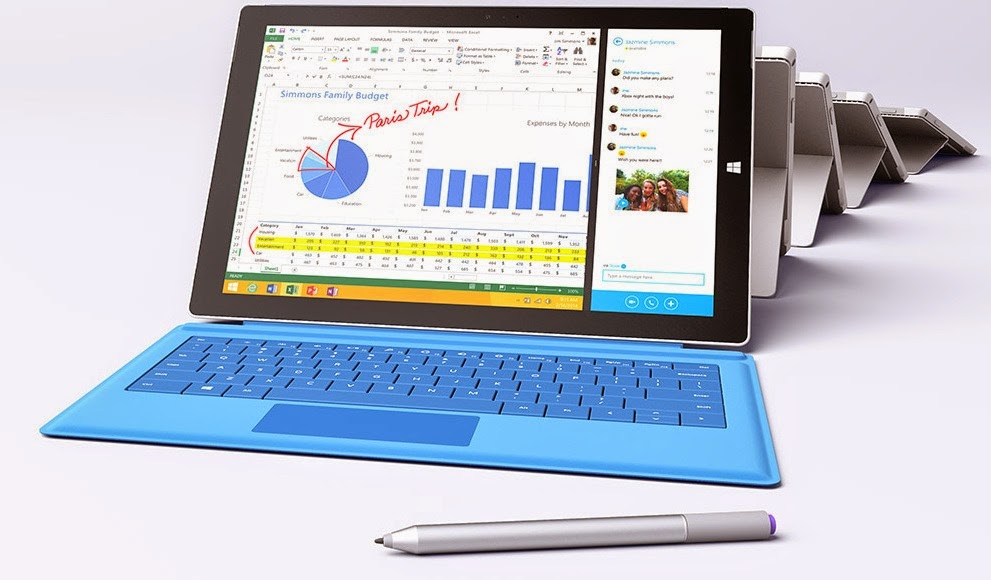
Surface Pro 3, despite having a large 12-inch screen with a 2160×1440 resolution, is only .36-inches thick and weighs less than two pounds. This incarnation of the Surface Pro also has a newly-designed kickstand that can be adjusted up to 150 degrees, a thinner type cover (not included; $130) that also features an improved keyboard and trackpad, and a new Surface Pen ($50) that can be clicked for commands. The Pro 3 will also come equipped with a new stylus and will be available in the following configurations:
- Core i3, 4GB RAM, 64GB – $799
- Core i5, 4GB RAM, 128GB – $999
- Core i5, 8GB RAM, 256GB – $1,299
- Core i7, 8GB RAM, 256GB – $1,549
- Core i7, 8GB RAM, 512GB – $1,949
The Opinion
Microsoft is really dropping the ball on the tablet world; because they have an opportunity to make their tablets much more utilitarian than an iPad by integrating with their dominant position in the living room and desktop arenas.
- They should be offering incentives (and well developed APIs) to PC and Xbox game developers to use windows powered tablets as auxiliary game controllers.
- They should be establishing the data pipeline to let desktop machines and the Xbox take some of the processor load off the tablet (over WiFi) to extend battery life.
- They should be positioning the tablet (and windows phones) as portable terminals into the spheres where they have established dominance; but by and large they aren't running that play as well as they should be.
*Product intro brought to you by Unscrambled blog. The Opinion was brought to you by an anonymous reader. Video courtesy of Microsoft.
July 24, 2013
Google Chromecast - Easiest Way to Enjoy Online Video and Music on Your TV

Sit back, watch together
With Chromecast, you can easily enjoy your favorite online entertainment on your HDTV—movies, TV shows, music, and more from Netflix, YouTube, Google Play, and Chrome. No more huddling around small screens and tiny speakers. Chromecast automatically updates to work with a growing number of apps.

Remote free
Chromecast works with devices you already own, including Android tablets and smartphones, iPhones®, iPads®, Chrome for Mac® and Chrome for Windows®. Browse for what to watch, control playback, and adjust volume using your device. You won't have to learn anything new.

Plug in and play
Get started in 3 easy steps: plug Chromecast into any HDTV, connect it to WiFi, then send videos and more from your smartphone, tablet or laptop to your TV with the press of a buttonAvailable now for only $35 at Best Buy and Amazon.com
October 22, 2012
Intel Wants To Increase Your Tablets Battery Life

Many of the methods being used to lower Haswell's power consumption are pretty conventional, and we touched on them a bit in our overview of the architecture: more power gating means that the CPU can turn off more parts of itself if they're not being used, and the Haswell platform can also transition between these different power states more quickly than could Ivy Bridge. The new S0ix system power states will also lower power consumption—these "active idle" states will allow the tablets to consume less power during light use like web browsing or checking e-mail, and they'll also enable the tablets to come out of sleep mode more quickly.
The most interesting part of the AnandTech piece isn't about how Intel will be reducing power usage in its own chips, but in how it will exert its reach over third-parties to lower power consumption of other non-Intel system components like voltage regulators and motherboard micro-controllers Intel wants to recommend not just specific components, but also things like component firmware versions, all in the name of saving power.
Intel even wants to dictate the components in displays—it wants manufacturers to begin putting small amounts of RAM into their display panels to make them capable of storing static images. That way, if a user is reading a document or Web page but not interacting with anything on the screen, the computer could display a static image of the screen rather than continuously refreshing it for no reason.
None of the Haswell platform's power management tweaks amount to huge savings by themselves, but taken together they add up to much improved potential battery life—if not comparable to ARM, then at least within spitting distance. The downside is that, to achieve the best results, Intel goes beyond the processor itself and begins dictating which components third-party manufacturers should and shouldn't use. This may maximize battery life, but if Intel succeeds in making serious inroads against ARM in the next few years, it puts a worrisome amount of control to put in the hands of a single company.
May 29, 2012
iPad Prototype, Dual Connectors, sells for $10,000

It may not have a Retina display or quad-core graphics. Hell, it’s not even brand new, or even very clean. But it’s a freak of iPad nature, and it just sold on eBay for $10,200.
As if witnessing the spectacle of a two-headed snake, Apple enthusiasts were awed by this prototype of the original iPad, which includes not one, but two dock connectors. Like all hardware companies, Apple creates a number of prototype designs to test product durability and performance, and flesh out ideas.
In this particular hardware study, it would appear that Apple was imagining a tablet that would have a dock connector positioned for both landscape mode and the portrait mode orientation with which we’re all familiar. It’s worth noting that Apple even went so far as to file a patent for the dual-dock connecting beast.
Whoever won the eBay auction paid a hefty price for a device that is “fully functional apart from the touch screen,” according to the listing. The seller noted that the clip that holds the display’s flex cable could be replaced, and that holding the connector down leads to sporadic touch functionality.
The nearly useless iPad is running Apple’s SwitchBoard suite, which is used for software debugging. The installed software, along with the second dock connector, helps substantiate the seller’s claim that the device is a prototype.
-By Roberto Baldwin for Wired.com
Whether your iPad cost you $10,000 or retail price, Limewit has a brand new Bluetooth Keyboard to go along with it. This wireless keyboard will allow you to type faster and add convenience when typing emails, working on school projects, or simply posting on Twitter and Facebook.
Unlike the iPad above, this keyboard is not a prototype and is fully functional.
Purchase today and save 15%! (click here)

Subscribe to:
Posts (Atom)
